


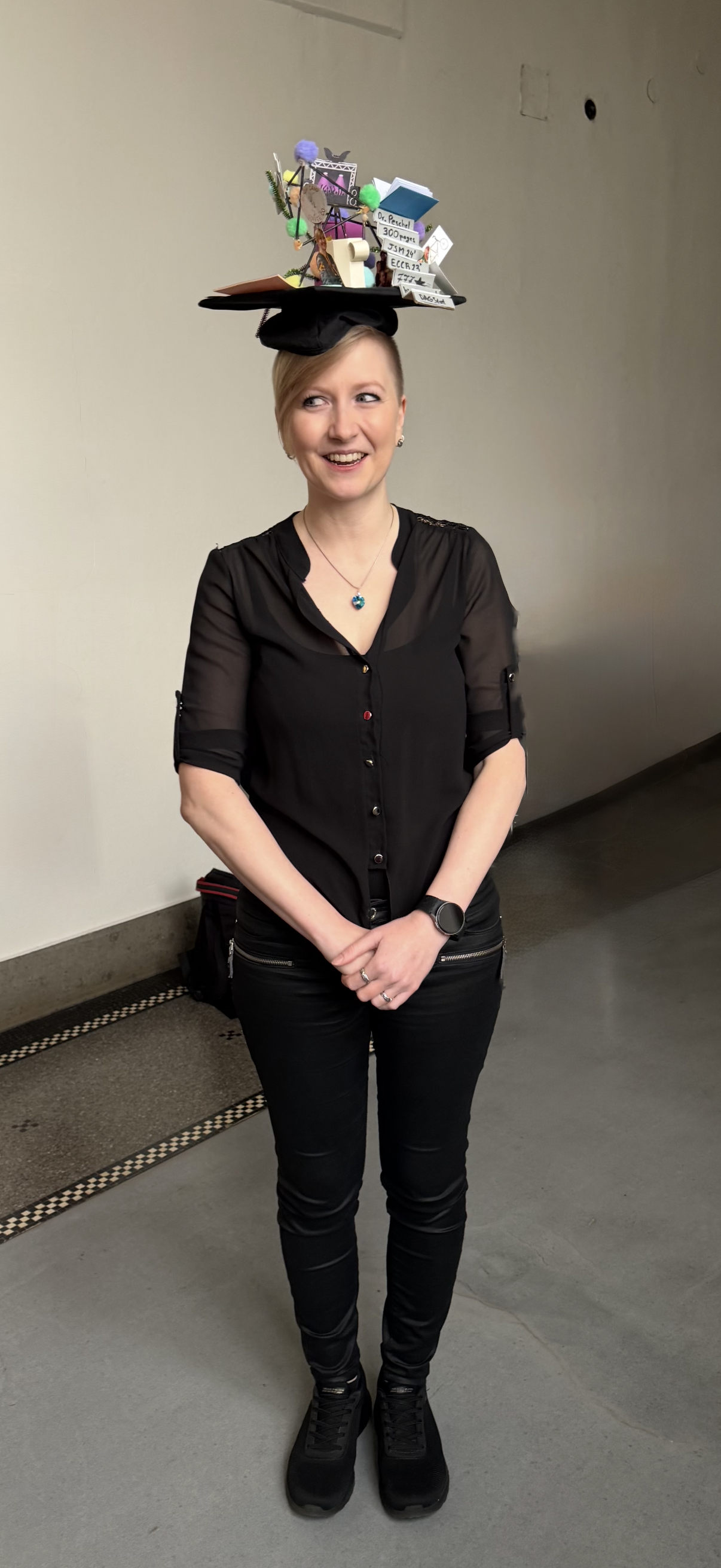
Successful defense of Stefanie Peschel
Congrats, Dr. Peschel!
We develop general statistical methods inspired by challenges in high-throughput biology. Sequencing, chemical genomics and flow cytometry motivate new ideas in computational statistics, statistical foundations and continuous optimization. Our research spans compositional data analysis, microbial chemical genomics, human and microbial single cells, microbiomes and oceanographic data.
Congrats, Dr. Peschel!
Leander will participate in the workshop Machine Learning for Spatially Resolved High-dimensional Biology.
Workshop ↗DM3L seminar: Playing in microbiology’s backyard: statistical methods and workflows for microbial data science across scales.
DM3L seminar programme ↗Alexander joins the annual meeting at the Simons Foundation.
Our research develops general statistical methods, computational statistics and continuous optimization, inspired by sequencing, chemical genomics and flow cytometry. Applications span microbial ecosystems, single cells and host–microbe interactions.
We contribute to Orchestrating Microbiome Analysis with Bioconductor (OMA), connecting our methods with reusable workflows for microbial network analysis and comparison.
Our q2-classo and q2-gglasso plugins bring compositional prediction and microbial network estimation into QIIME 2, linking statistical method development to a broader community of researchers and developers.
Shared ideas, mountain walks, meals and celebrations—some moments from life in and around BioDS.
Explore group life ↓
Helmholtz Munich · LMU Munich · Flatiron Institute
GitHub ↗PhD student
· LinkedIn ↗
PhD student
Website ↗
PhD student
Website ↗
PhD student
Website ↗

PhD student
Website ↗
PhD student
Website ↗Conferences, celebrations and time together beyond the desk. Select a photo to see it in full.

Computational scientist · EMBL Heidelberg
Website ↗
CMC Statistician · Boehringer Ingelheim
Website ↗
Siemens Healthineers · former PhD researcher and postdoc
LinkedIn ↗Tenured Faculty · CISPA
Profile ↗ · Website ↗Visiting PhD student · 2024
Postdoctoral Fellow · ETH AI Center · mentors Gunnar Rätsch and Niko Beerenwinkel
ETH profile ↗

Junior group leader · Integrative Data Science, Augsburg
Profile ↗ · Website ↗
Postdoctoral researcher · Institute of Virology, Helmholtz Munich
Profile ↗Systems Consultant · Robotron, Dresden
XING ↗
Assistant Professor · Johns Hopkins University
Faculty profile ↗Master’s thesis alumnus · now on the current PhD team
Website ↗Biostatistician · Eli Lilly and Company · Ireland
LinkedIn ↗Master’s thesis alumna · now on the current team
Website ↗ · LinkedIn ↗Munich Re
LinkedIn ↗Master’s thesis alumnus · STAT-UP
STAT-UP’s LinkedIn introduction ↗Data Scientist · Staburo GmbH
LinkedIn ↗

Novartis · Basel
LinkedIn ↗Bachelor’s thesis alumnus
Bachelor’s thesis alumnus
LinkedIn ↗
Flatiron Institute · now Assistant Professor of Statistics, University of Georgia (UGA)
Profile ↗
What each package does, where to start, and the research behind it.
We develop q2-classo and q2-gglasso for compositional prediction and microbial network estimation in QIIME 2.
Stefanie Peschel and Christian L. Müller contribute to Orchestrating Microbiome Analysis with Bioconductor, particularly microbial network analysis and comparison.
Publications, preprints and other scholarly works, newest first. Updated from the November 2026 Google Scholar export, with duplicate citations consolidated and author misattributions omitted.
Proposed research directions grouped by statistical sub-topic, with starting papers and related proposals. Final scope, supervision and data access are agreed individually.
Courses and seminars connecting computational statistics with biomedical data science.
Statistical concepts and computational methods for modern biological measurements—from sequencing and multi-omics to single-cell and microbiome data.
Lecture notes connect model assumptions, methods and interpretation. The course combines statistical foundations with biological examples.
An overview of different fields of statistics through guest lectures from research and professional practice. Students discover contemporary applications, research directions and perspectives beyond individual specialist courses.
Semester-specific schedules and access information are provided through LMU. Moodle may require sign-in.
Our seminars explore statistical methods and their use in biomedical research. Students engage with scientific papers, discuss methodological questions and connect theory with reproducible data analysis.
Statistical methods for understanding collective bacterial organization and integrating measurements across scales.
Simons Collaboration on Computational Biogeochemical Modeling of Marine Ecosystems. Quantitative models of marine microbial communities and their environment.
Statistical Learning Along Oceanographic Transects.
Statistical analysis and synthesis of oceanographic observations to understand marine microbial ecosystems.
MUDS provided initial funding for the group, supporting the doctoral research of Mara Stadler and Oleg Vlasovets.
Joint project with Sebastian Stich at CISPA, developing efficient, theoretically grounded optimization methods for structured deep-learning models and multimodal data integration.
A former funded collaboration linking experimental microbiology with statistical analysis of growth and reporter-screen data.
From Single Cells to Microbial Communities.
Listed here as previous funding of our group; this does not imply that the wider programme has ended.
Helmholtz AI support and collaboration, retained from the group’s existing funding page.
Leander Schwarzmeier · NeurIPS 2026 workshop.
Christian L. Müller · University of Zurich.
Christian L. Müller · Institute for Molecular Infection Biology, University of Würzburg.
Christian L. Müller · Helmholtz Centre for Environmental Research, Leipzig.
Alexander Dell’Orti · Simons Foundation.
Our group contributed to the interactive travelling exhibition Bakteriopolis at Schwanthalerhöhe in Munich, sharing the world of microbes with visitors of all ages.
An interview with Roberto Olayo Alarcon about molecular representation learning and the group’s research.
For research collaborations, student projects and visits, contact Christian L. Müller.